

Assessment
Misconceptions for LED Screens
- ... prevent and protect yourself effectively


With the following information, we would like to dispel some of the myths, misconceptions and planning errors that we have encountered in the last few years.
The following statements are based on practical experience as well as our own scientific research and reviews and do not represent a conclusive picture of the market.
However, our aim is to raise awareness of the challenges involved.
Due to a lack of practical solutions and tangible insights, LED screens have often been installed in areas in the past where legislators actually impose clear requirements on fire performance (At least flame-retardant or non-flammable).
However, these were not complied with. Find out why this represents a risk for you Here.
Myth 1:
Drip trays
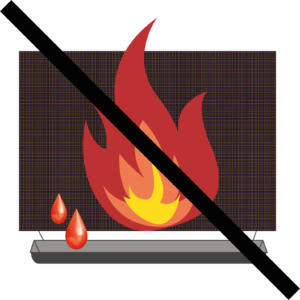
So-called drip trays are used in various stadiums, escape routes, meeting places etc. as part of fire protection concepts.
The idea behind this is that, in the event of a fire, the plastic of the LED screen liquefies and drips down beneath the screen into a so-called laptop tray (usually only a few centimeters deep) located beneath the screen, intended to protect the people sitting or escaping below from the dripping plastic.
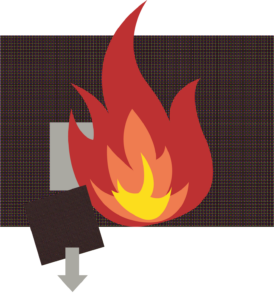
All tests ever carried out in recognized testing facilities have shown that none of the products we know and have tested exhibit these flow properties or collect in a drip tray. Instead, entirely different challenges arise – namely that whole plastic parts fall out of the LED screens. This is far more logical, as the plastics soften and entire modules, sometimes still burning, can fall down onto people.
Myth 2:
Extinguishing systems
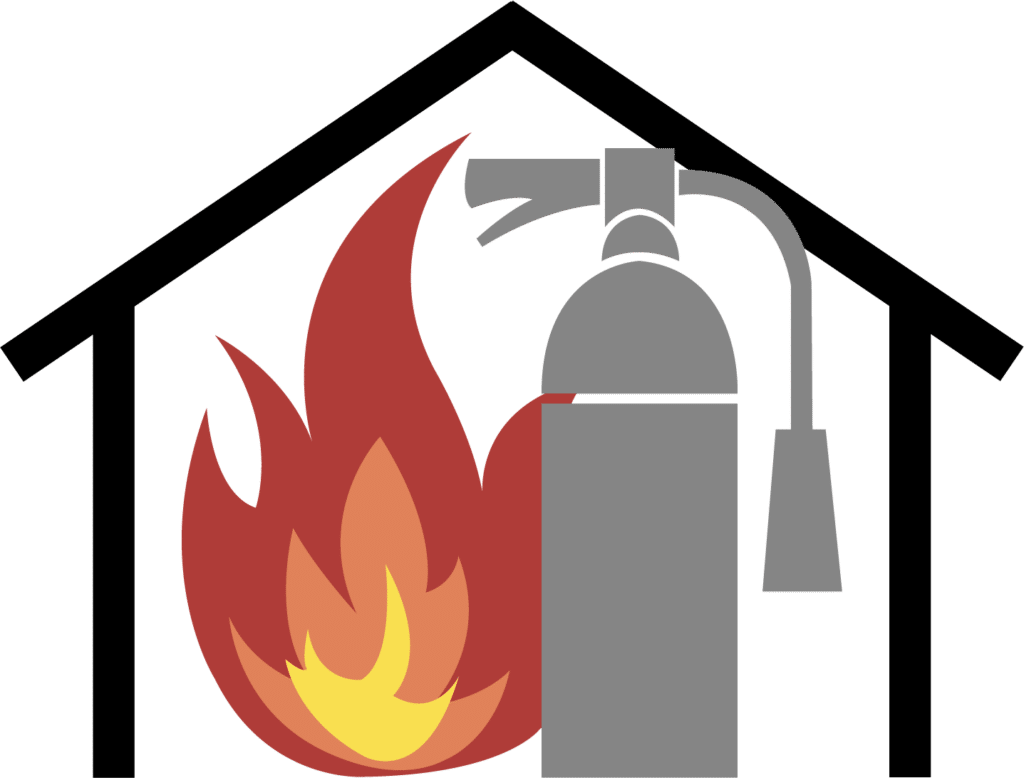
There are so-called fire extinguishing systems propagated by various representatives on the market that are intended to prevent an LED screen from causing a fire within the building. These fire extinguishing systems work wonderfully, provided that this property has not already been realized by VDE specifications (fire protection switch AFDD, FI switch, etc.). The law clearly ststes which fire behavior must be fulfilled as a minimum in which area. However, a fire extinguishing system has no influence on this fire behavior, which can only be demonstrated on the front or back of a flat product. These fire extinguishing systems only prevent the development of a fire on the inside. An improvement in fire behavior is not achieved.
Myth 3:
Orientation fire tests
The LED screen manufacturing industry often takes the view that LED screens are an electronic product and not a construction product. Nevertheless, the legislator deliberately uses the word “wall cladding” in the state building regulations, for example, in order to include all products which form the top skin of a wall. From the legislator's point of view, this covers all products that can be a risk and meet the protection standards in line with §3 MBO .
Other manufacturers only carry out so-called “indicative” fire tests due to a lack of specialist knowledge or sometimes to deliberate concealment. These orientation fire tests are not carried out in line with standards and are incomplete in the area (cf. EN13823 or DIN 4102) and lead to a result that is meaningless.

Only tests carried out in line with standards can be used for assessment.
All other approaches that do not comply with the standard represent an enormous risk for the expert in preventive fire protection as well as the building owner in the event of damage because the orientation fire tests do not allow a conclusive assessment.
The TU Munich has recently carried out a study dealing with the fire behavior of LED screens, which showed that preliminary fire tests do not allow for reliable conclusions and that all products were testable in compliance with standards. See here.

Myth 4:
Test reports from abroad
Other manufacturers often try to prove their fire behavior with test reports and test certificates from abroad (e.g. SGS from China). However, the legislator only accepts tests conducted by so-called PÜZ bodies of the DIBt or by testing laboratories that are accredited at the European level (NANDOand designated as notified bodies. If foreign test certificates are used for assessment, this creates a significant liability risk — both for preventive fire protection and for the operator — since the results are not verified. In practice, deviations have also been identified in the course of the study. See here. See here.
Are you unsure how to proceed with the assessment of the documents submitted? Contact us, we will help you with a free initial assessment.
The content presented here does not constitute binding legal advice. The exact circumstances depend on the respective installation situation of your building project. The information provided here is based on legislation and the speaker's experience of project-related construction projects and describes the situation in Germany.
Author: Tobias Kick, expert for LED screens and preventive fire protection, 25.05.2025
Please contact us for a free, no-obligation initial assessment.